
 M&M
M&M
1 min read
TIW Valve vs. IBOP Valve - What's the Difference?
 M&M : Mar 26, 2026, 4:00:00 AM
A TIW valve is a manual ball valve stabbed into the drill string at surface for emergency shutoff. An IBOP valve is an automatic poppet-style...
|
An IBOP valve (Internal Blowout Preventer) is an automatic drill string safety valve that closes without crew input to stop uncontrolled flow during a kick. It seals the bore from inside the pipe, protecting surface equipment and personnel while complementing the external BOP stack. |
Most drilling engineers have spec'd IBOP valves before. Fewer have had the opportunity to dig into the engineering decisions that separate a reliable, long-service valve from one that becomes an NPT problem at the worst possible moment. This guide is built for that second conversation; the one where specification meets real well conditions, and where the right call on an IBOP valve protects both the well and the people on it.
M&M Oil Tools has been manufacturing well control equipment since 1944. What follows reflects decades of applied experience across Gulf of Mexico operations, HPHT wells, offshore platforms, and sour service environments.
An IBOP valve (Internal Blowout Preventer) is a drill string safety valve that automatically stops uncontrolled flowback from inside the drill string. Where a surface BOP stack seals around the outside of the pipe at the wellhead, the IBOP seals from within - protecting the top drive, swivel, kelly hose, and surface pumping equipment when formation pressure reverses flow up the drill string.
IBOP valves can be installed anywhere in the drill string and are a required component of well control plans on most offshore and HPHT drilling operations. They function as a redundant internal barrier, complementing, not replacing, the surface BOP stack.
Well control engineering is built on the principle of redundant barriers. The surface BOP controls the annular space. The IBOP controls the inside of the drill string. Neither alone is sufficient in high-risk environments. Both working together is what the well control standards are built around.
💡 A quick note on terms: "IBOP" and "inside BOP" refer to the same equipment — "inside" simply distinguishes it from the surface BOP stack. For the full terminology breakdown plus standard vs. H₂S-trim selection, see our inside BOP specs & H₂S-trim reference.
The automatic closure mechanism is what makes an IBOP valve a critical well control barrier and understanding it helps you evaluate whether a valve will perform when conditions are at their worst.
Here's the sequence during a kick event:
The critical phrase in step 2 is without rig crew intervention. In an H₂S environment or a fast-moving kick, the time between detection and incapacitation can be seconds. An IBOP valve that closes automatically is not a convenience feature, it is the design requirement.
M&M's poppet-style IBOP valves feature a conical nose and metal-to-metal seat machined from high-strength materials. The geometry of the poppet, seat, and bypass area is specifically engineered to minimize erosion under long-term, high-rate circulation; one of the primary failure modes in offshore and HPHT service where valves are cycled repeatedly under extreme conditions.
An optional release assembly allows M&M's IBOP to function as a standby surface safety valve: quickly stabbed into drill pipe, tubing, or casing at the rig floor if a kick is detected during tripping operations.
💡 How does an IBOP valve close automatically?An IBOP valve uses a spring-loaded poppet mechanism that responds to flow direction inside the drill string. During normal circulation, pump pressure holds the poppet open so drilling fluid flows downward through the string. When formation pressure exceeds pump pressure and reverses flow upward — the signature of a kick — that upward force overcomes the spring and drives the poppet into a metal-to-metal seat, sealing the bore. The entire sequence is pressure-driven and requires no crew input, no surface signal, and no actuator. Once wellbore pressure is equalized and normal circulation resumes, the poppet reopens automatically. The tolerances on that seat and bore are what make the seal hold — see how in-house machining keeps them consistent. |
Upper and lower IBOPs are not interchangeable components. They serve distinct mechanical functions and occupy specific positions in the drill string. Misunderstanding this distinction leads to gaps in well control coverage that audits and incident investigations consistently flag.
The upper IBOP is positioned above the top drive quill or saver sub. It is a manual valve — requiring wrench or actuator input to open and close. Its primary role is tripping operations: when the drill string is out of the hole and wellbore pressure builds, the upper IBOP gives the crew a rapid, reliable manual shutoff point above the top drive.
What this means operationally: The upper IBOP requires a crew member to actuate it. In H₂S environments or fast-developing well control events, that dependency is a known limitation - which is why it is always paired with an automatic lower IBOP in top drive systems.
The lower IBOP is positioned below the top drive quill, directly in the active flow path during drilling and circulation. This is the automatic valve. When formation fluid pushes back up the string, the poppet closes without any human input. No signal, no actuator, no waiting for a crew response.
What this means operationally: The lower IBOP is the primary automatic barrier against an internal blowout during active drilling. In top drive systems, it is doing the real-time well control work.
In standard top drive practice, both valves run in tandem. The lower IBOP handles automatic event response; the upper IBOP provides manual backup and a way to isolate the drill string above the top drive for maintenance, tripping, or secondary control.
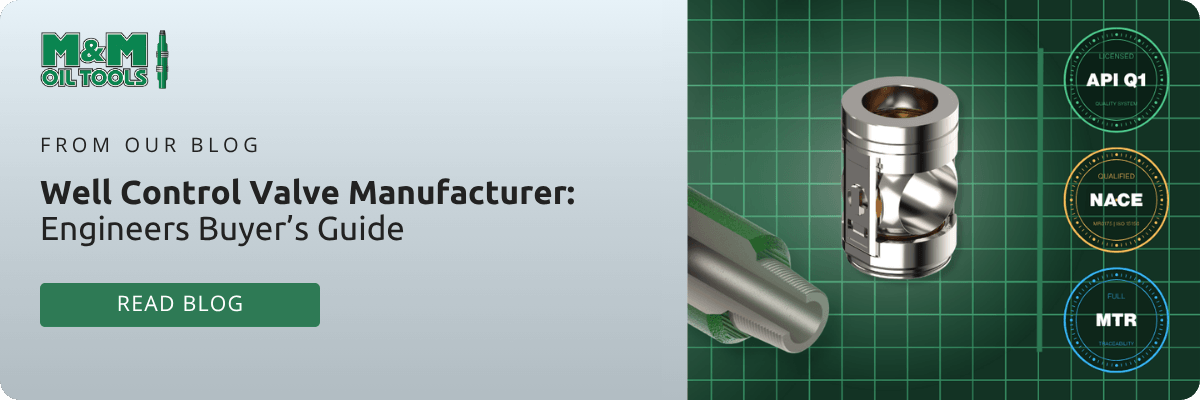
Selecting an IBOP valve for demanding environments is an engineering decision, not a procurement checkbox. The specifications below are the ones that separate valves that hold up under real well conditions from those that create the NPT and reliability problems operators are trying to avoid.
Standard operations typically require a 10,000 psi working pressure rating. HPHT wells regularly demand 15,000 or 20,000 psi ratings. The valve's rated working pressure must exceed the maximum anticipated surface pressure (MASP) for your well program — with the safety margins defined by your operator's well control policy and applicable standards (API RP 53, NORSOK D-010, or equivalent).
In any well with H₂S potential, sour service trim is not optional. M&M's IBOP valves are manufactured to H₂S trim as standard across the product line — eliminating the need to stock and track separate sour and sweet service inventory, and removing the risk of a wrong-valve deployment in a sour environment.
Elastomer seats degrade under thermal cycling, high differential pressure, and H₂S exposure — conditions that are standard in HPHT and offshore service. Metal-to-metal seating maintains sealing integrity where elastomer designs fail. For HPHT and offshore specs, this is a non-negotiable design requirement, not an upgrade.
Long-duration, high-rate circulation is the operating reality in many offshore programs. Valve internals that aren't designed for it show erosive wear at the poppet, seat, and bypass area — shortening service life and creating unplanned replacement costs. M&M's bypass geometry is engineered to distribute flow and minimize erosive wear, extending intervals between replacements.
M&M's IBOP valves are available in both one-piece and two-piece construction. Two-piece designs allow valve internals to be replaced in the field without removing the entire string connection — reducing rig floor NPT during scheduled maintenance or post-event inspection.
Top drive IBOPs must match the OEM's connection specifications exactly: box and pin thread type, saver sub compatibility, and torque capacity are all critical. Contact M&M's engineering team for OEM-specific compatibility guidance before ordering.
Need an IBOP rated for HPHT or sour service on an upcoming workover? M&M builds every valve to H₂S trim as standard.
💡 What pressure rating do I need for an IBOP valve?Your IBOP valve's rated working pressure must exceed the maximum anticipated surface pressure (MASP) for your well program, plus the safety margin defined by your operator's well control policy. Standard drilling operations typically call for a 10,000 psi working pressure rating. HPHT wells routinely require 15,000 psi or 20,000 psi ratings. The governing references are API RP 53 for general well control equipment and API RP 96 for deepwater and HPHT applications. When in doubt, spec to the highest MASP scenario in the well program — underrating an IBOP creates a barrier gap that no amount of procedural control can close. |
The regulatory baseline for IBOP valves is well-established, but best-practice application goes beyond minimum compliance and experienced operators know the difference. IBOP valves are required or strongly recommended in the following contexts:
Beyond regulatory requirements, prudent well control practice calls for IBOP valves to be function-tested, inspected, and staged at the rig floor even when not actively run - ready to be stabbed into drill pipe, tubing, or casing at any point during operations.
Relevant standards and references:
💡 Are IBOP valves required on all drilling rigs?Not universally by regulation, but close to it in practice. BSEE 30 CFR Part 250 requires a drill string safety valve on the rig floor for all Outer Continental Shelf operations. API RP 96 and NORSOK D-010 address IBOP requirements for HPHT and deepwater wells. Top drive drilling systems require upper and lower IBOP pairs as standard practice because there is no kelly bushing to serve as a secondary manual seal point. Beyond regulatory minimums, most major offshore operators and drilling contractors include IBOP valves in their well control procedures regardless of jurisdiction — particularly in H₂S environments where automatic closure is critical due to crew incapacitation risk. |
IBOP valves don't operate in isolation. They're one component in an integrated well control valve system.
Understanding the full picture helps drilling engineers and procurement teams build complete, code-compliant barrier programs.
All M&M well control valves are designed and built as H₂S trim, designed for both offshore and onshore operations without the need for separate service-specific inventory.
Read More: Complete guide to well-control valves and IBOP equipment →
The cost of well control failures isn't measured in valve price, it's measured in NPT, remediation, regulatory exposure, and liability.
Experienced procurement managers and drilling engineers know this, which is why the total cost of ownership calculation for an IBOP valve looks different from most line items. The variables that drive that calculation: service life under your specific well conditions, maintenance intervals, field replaceability, and what happens when the valve is tested at MASP and it holds versus when it doesn't.
M&M's IBOP valves ship with mill certificates, test reports, and a Certificate of Conformance with every unit. With thousands of valves operational around the world (across Gulf of Mexico, offshore, HPHT, and sour service environments) M&M's product line carries a performance record that commodity alternatives don't.
View M&M's IBOP Valve Specifications →
Have questions about our IBOPs or need help with the discovery phase of your project? Get in touch with us today!
Contact Us · +1 (877) 240-9564
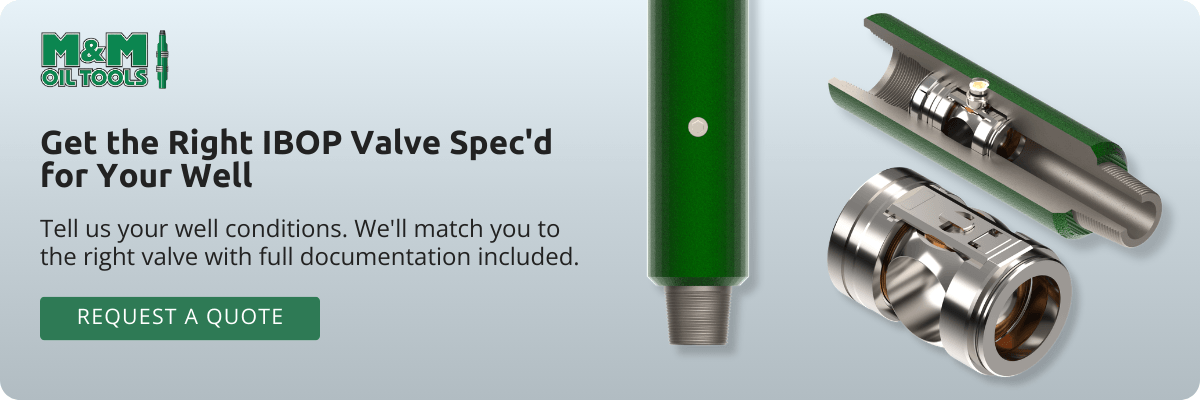
An IBOP (Internal/Inside Blowout Preventer) valve is a drill string safety valve that stops uncontrolled flow from inside the pipe during a kick. M&M's poppet-style IBOP closes automatically when formation pressure reverses flow up the string — no crew input required — sealing the bore metal-to-metal and protecting the top drive, swivel, and surface equipment. It complements, but does not replace, the surface BOP stack.
IBOP stands for Internal Blowout Preventer (also written Inside Blowout Preventer). It is a safety valve installed inside the drill string that closes to stop uncontrolled fluid flow — a kick or blowout — from traveling up through the drill pipe toward the surface and rig equipment.
The upper IBOP is a manual valve positioned above the top drive quill, used to shut off the drill string during tripping or emergencies. The lower IBOP is an automatic poppet-style valve positioned below the quill that closes without human intervention when formation pressure reverses flow. In top drive systems both run together: the lower provides automatic protection during drilling; the upper provides manual backup and tripping coverage.
A poppet-style IBOP is held open by spring tension during normal circulation. When formation pressure exceeds pump pressure and reverses flow upward — the signature of a kick — that upward force overcomes the spring and drives the poppet into a metal-to-metal seat, sealing the bore. The sequence is pressure-driven and needs no crew input, surface signal, or actuator. The poppet reopens automatically once circulation is restored.
IBOP valves are required for offshore drilling under BSEE 30 CFR Part 250, HPHT wells per API RP 96 and operator-defined MASP thresholds, top drive drilling systems, wells with H₂S potential, and managed pressure drilling programs. Most operators also include IBOP valves as standard well control equipment regardless of minimum regulatory requirements.
A top drive IBOP is an IBOP valve configured for top drive quill connections, run as an upper/lower pair — a manual upper and an automatic lower — providing both manual and automatic well control barriers during drilling and tripping. Thread type, saver sub compatibility, and torque ratings must match the top drive OEM's specifications.
A surface BOP seals around the outside of the drill pipe or casing at the wellhead, controlling pressure in the annular space. An IBOP seals the bore of the drill string from the inside, stopping flow from traveling up through the pipe. They are complementary barriers — surface BOPs control the annulus; IBOPs control the inside of the drill string.
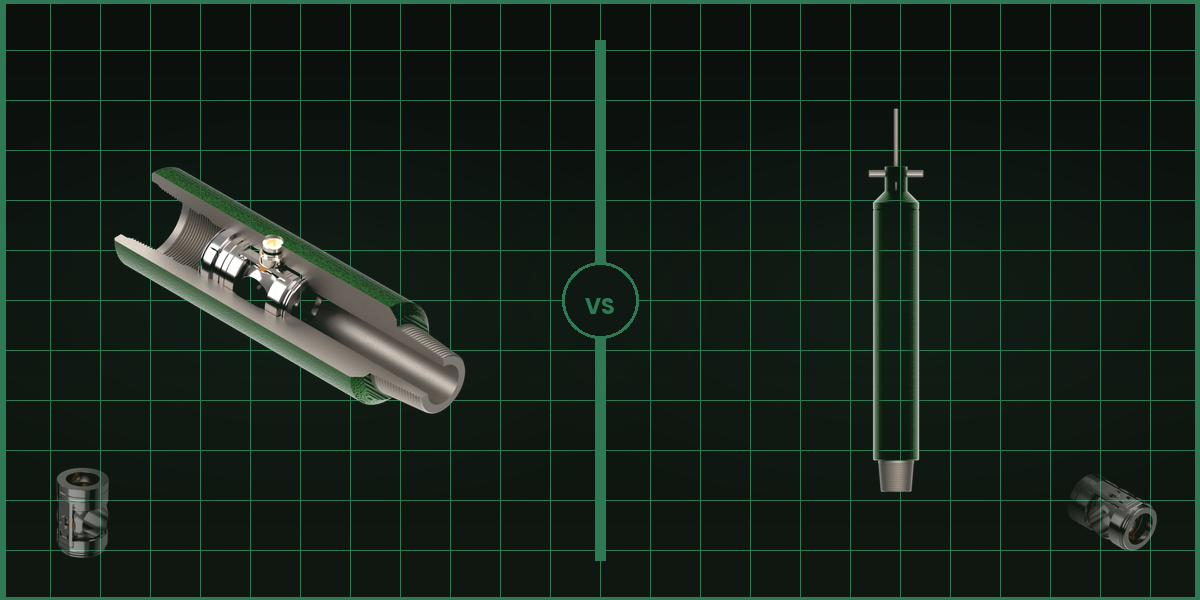
Both are drill string safety valves, but a TIW valve is a manual ball valve used at surface, while an IBOP is typically the automatic poppet-style valve run in the string. See the full comparison in our TIW valve vs. IBOP valve guide.
1 min read
M&M : Mar 26, 2026, 4:00:00 AM
A TIW valve is a manual ball valve stabbed into the drill string at surface for emergency shutoff. An IBOP valve is an automatic poppet-style...
.png)
1 min read
M&M : May 20, 2026, 1:53:36 PM
An inside BOP — also called an IBOP (Inside Blow-Out Preventer) — is a full-opening safety valve installed in the drill string just below the...
.png)
1 min read
M&M : Apr 15, 2026, 2:15:06 PM
A qualified well control valve manufacturer carries an active API Spec Q1 license, provides full material traceability on every...