
6 min read

Wellbore Cleanup: The Checklist for Drilling and Workover Teams

Wellbore Cleanup: A Pre-Completion Checklist for Drilling & Workover Teams
11:21

Wellbore cleanup is the difference between a completion that holds for years and one that fails within months. After drilling, milling, or any workover operation, the inside of your casing carries a film of pipe dope, mill scale, rust, drilling fluid solids, and cement filter cake. Set a packer, sand screen, or plug on top of that residue and the sealing element won't seat properly. The leak might show up on the pressure test, or it might wait until production economics depend on the well. 

This checklist gives drilling and workover crews a repeatable pre-completion sequence built around the two tools that do most of the work - casing scrapers and casing brushes.


What Is Wellbore Cleanup?

Wellbore cleanup is the mechanical and chemical removal of debris, scale, and residual fluids from the inside of casing before a completion or workover operation. The process typically runs in three phases: a mechanical scrape to dislodge bonded solids, a wire or synthetic brush pass to sweep loosened material into circulation, and a chemical pill train that suspends fines and lifts them to the surface. The goal is a clean, smooth sealing surface at every depth where downhole hardware will set.

Operator case studies consistently identify inadequate cleanup as one of the top drivers of remedial workover work.  Cleanup happens at predictable points in the well plan: after primary cement, before a packer or liner hanger run, between zonal isolations during a workover, and any time milling or fishing has generated debris downhole.


The term "wellbore cleanup" is sometimes used interchangeably with "hole cleaning," "casing cleanup," or "displacement." In practice, hole cleaning refers to cuttings transport during drilling, while wellbore cleanup specifically targets pre-completion debris removal.


Why Does Wellbore Cleanup Matter Before Completion?

When a completion fails early, the root cause usually traces back to what was - or wasn't - cleaned off the casing wall before the hardware went in the hole.

Three failure modes drive most remediation work:

  • Packer slip and seal failure. A packer's elastomeric element needs continuous metal-to-rubber contact across the entire setting depth. Mill scale and pipe dope create voids that bypass pressure during the test or under production drawdown.
  • Sand screen plugging. Drilling fluid solids settling on the screen face reduce open-flow area before the well sees its first barrel. Productivity loss can run 20% or more, depending on screen design.
  • Plug and bridge plug failures. Cement or scale on the casing wall keeps slips from biting properly, leading to plug movement under differential pressure.

Operator-side reporting in World Oil consistently identifies hole cleaning as one of the top contributors to non-productive time in the completion phase.


The Pre-Completion Wellbore Cleanup Checklist

This sequence works for most vertical, deviated, and horizontal completions. Adjust based on hole geometry, fluid system, and the type of completion hardware going in.

Step 1: Build the Plan From Well History

Pull the well file before you spec the run. You need the casing size and weight, the deepest packer or plug setting depth, the fluid system currently in the hole, and any prior milling, fishing, or cement squeeze work. Each of those changes the tool selection.

A cleanup that targets only the packer setting depth will miss debris that falls past it during circulation. Plan to cover the entire interval from the deepest setting depth to surface, with concentrated passes at each sealing point.

Step 2: Run the Casing Scraper

The casing scraper does the heavy mechanical work. Spring-loaded blades contact the casing wall and shear off bonded mill scale, cement, rust, and hardened pipe dope. Make a minimum of three passes through each target interval, with rotation if the BHA allows it. Pick up off bottom and circulate between passes to clear the annulus.

Match scraper size to nominal casing ID, not OD. A scraper that's too small leaves a contact gap; one that's too large drags and risks getting stuck. M&M Oil Tools stocks casing scrapers for common API sizes from 4-1/2 in. through 13-3/8 in., with replaceable blade cartridges that simplify field servicing.

Step 3: Follow With a Casing Brush

Once the scraper has dislodged the bonded debris, the casing brush sweeps the wall and works loosened material into the circulating fluid. Brushes come in wire and synthetic configurations - wire for aggressive cleaning of cement and scale, synthetic where you need to protect chrome or coated tubulars from scratching.

Run the brush on a circulating BHA with a pump rate high enough to lift debris out of the annulus. A brush without circulation just moves debris around the wellbore.

Step 4: Pump the Chemical Pill Train

The mechanical work loosens debris; the chemical pill train carries it to surface. A standard train includes:

  1. A push pill - typically viscosified water or brine - that displaces hole fluid ahead of the cleanup chemistry.
  2. A surfactant pill that breaks emulsions and releases oil-wetted solids from the casing wall.
  3. A viscous sweep that suspends solids in turbulent flow and lifts them up the annulus.
  4. A spacer pill that separates the cleanup chemistry from completion fluid going in behind it.

Pill volumes depend on hole geometry.Pill delivery depends on reliable surface pumping equipment - a charge pump that can't hold steady rate will compromise the spacer separation between cleanup chemistry and completion fluid. A common starting point is enough volume to cover 500 ft of annular space at each stage. Reporting in the Journal of Petroleum Technology covers field results from various pill train designs that practitioners can use as benchmarks.

Step 5: Verify Cleanliness

Catch returns at the shaker and inspect. If you're still seeing scale flakes, cement chunks, or visible solids after the planned sequence, run additional brush passes before bringing in completion fluid. Some operators run a final filter on the active system to qualify the fluid going into the well.


When To Use a Casing Scraper vs. a Casing Brush?

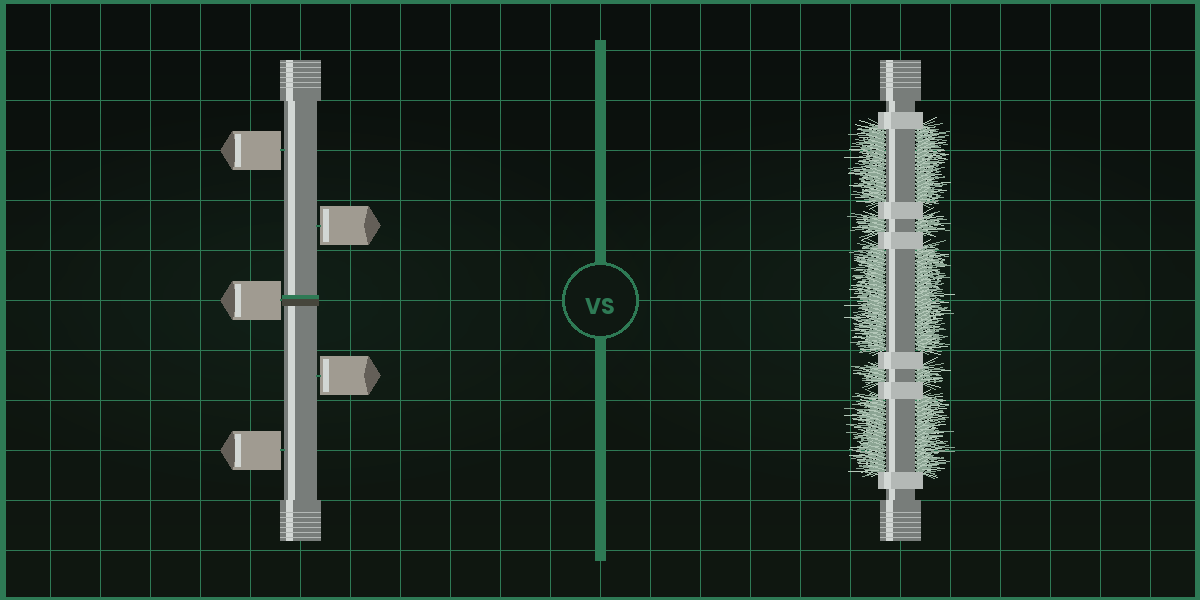
Both tools belong in the cleanup BHA. They do different jobs and are sequential rather than interchangeable.

Tool Primary Function Best Use Case Key Limitation

Casing Scraper

Spring-loaded blades mechanically shear bonded mill scale, cement, and hardened pipe dope from the casing wall.

Heavy debris loads, post-milling cleanup, and any well that has been sitting with cement or scale buildup on the casing surface.

Cannot move fine particulate or oil-wetted solids without supporting circulation and chemical pill work.

Casing Brush

Sweeping action dislodges fine debris from the casing wall and works it into the circulating fluid stream.

Light cleanup after a scraper pass, chrome or coated tubular preservation, and final polish before completion hardware runs in.

Cannot remove hard bonded scale or cement on its own - the scraper has to run first.

Skip the scraper and the brush has nothing to sweep against bare metal. Skip the brush and the scraper-loosened debris settles back onto the casing wall during static periods.


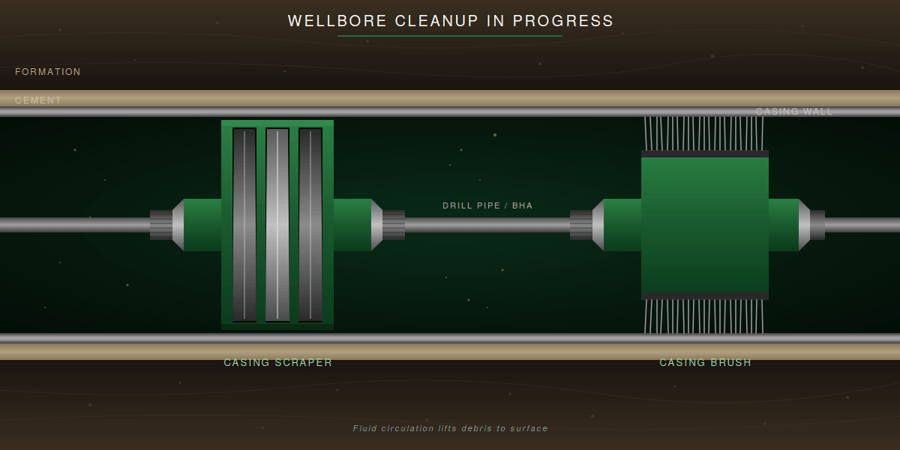
Cross-section diagram of wellbore cleanup in progress showing a casing scraper and casing brush running through cased hole with cement annulus and formation.


Common Wellbore Cleanup Mistakes

Even experienced crews fall into the same patterns when a cleanup goes wrong. Five repeat problems show up across most failed runs:

  1. Treating cleanup as optional. When schedules tighten, the cleanup BHA gets cut first. The cost shows up later as remedial work that runs 5 to 10 times the price of the original cleanup run.

  2. Wrong brush material on coated casing. Wire brushes will scratch chrome and inhibitor-treated tubulars. Match brush type to casing metallurgy before the BHA goes in the hole.

  3. Inadequate circulation time. A scraper or brush passing through at trip speed without circulation just relocates debris. Build cleanup time into the well plan.

  4. Generic pill chemistry. Mud type matters. An oil-based mud cleanup needs different chemistry than a water-based mud cleanup. Talk to your fluids vendor about the actual hole fluid before spec'ing pills.

  5. No verification step. If nobody is catching returns and inspecting, you don't know whether the cleanup worked. Build a sign-off step into the procedure.

The pattern across all five is the same: cleanup gets treated as a procedural box-check instead of an engineered step in the well plan. Crews that build cleanup into the AFE, spec the BHA against actual well conditions, and assign someone to verify returns rarely see these failures repeat. The tools matter, but the discipline around how they're run matters more.


Have questions about our casing scrapers and brushes or need help spec'ing the cleanup BHA for your next completion? Get in touch with us today!

Contact Us  ·  +1 (877) 240-9564


Frequently Asked Questions


How many casing scraper passes are needed for adequate wellbore cleanup?

Most cleanup procedures call for a minimum of three full passes through each target interval, with circulation between passes. Heavier debris loads - particularly after milling operations or in wells that have been static for an extended period - may require five or more passes. The verification step at surface tells you when to stop: when returns come back clean for a full bottoms-up circulation, the scraper has done its job. Adjust pass count based on what you see at the shaker, not on a fixed number from the procedure.

Can a casing brush replace a casing scraper?

No. The two tools handle different debris types and work as a sequence rather than alternatives. A casing scraper uses spring-loaded blades to mechanically shear bonded mill scale, cement, and hardened pipe dope from the casing wall. A casing brush sweeps loosened debris into the circulating fluid but cannot remove bonded material on its own. Running a brush without a prior scraper pass leaves the hard debris in place. Both tools belong in the cleanup BHA, with the scraper running first.

When should wellbore cleanup happen during the well plan?

Wellbore cleanup runs at any transition point where completion hardware will set against the casing wall. The most common timing is after primary cement and before the packer or liner hanger goes in. Workover operations require cleanup between zonal isolations and after any milling or fishing work. Any time debris has been generated downhole, or any time a sealing element will set on the casing, cleanup belongs in the sequence before the next operation starts.

What is the difference between wire and synthetic casing brushes?

Wire casing brushes use steel bristles for aggressive removal of cement, scale, and other hard deposits from standard carbon steel casing. Synthetic brushes use polymer bristles that clean the casing wall without scratching chrome-plated, inhibitor-treated, or coated tubulars. Use wire brushes for new drilling completions in standard carbon steel casing, and synthetic brushes for workover operations where preserving the casing surface coating matters for corrosion resistance and long-term well integrity.


Sources & Standards Referenced

  • World Oil — industry publication covering operator reporting on hole cleaning and non-productive time during completion operations (worldoil.com)

  • Journal of Petroleum Technology (JPT) — Society of Petroleum Engineers publication covering field results and benchmarks for displacement and pill train design (jpt.spe.org)


Green M from the M&M Oil Tools logo with their graphic illustration of a green valveAbout Us

M&M Oil Tools has served the oil and gas industry since 1944, manufacturing IBOP valves, kelly and safety valves, casing scrapers, casing brushes, and surface test trees from our purpose-built facility in Breaux Bridge, Louisiana. Made in the USA. Every valve ships with mill certificates, test reports, and a Certificate of Conformance.
Contact Us · +1 (877) 240-9564 · mmoiltools.com

Casing Scraper vs. Casing Brush - Which Do You Need for Wellbore Cleanup?

Casing Scraper vs. Casing Brush - Which Do You Need for Wellbore Cleanup?

In this guide: What casing scrapers and casing brushes do, the key mechanical differences between them, when to use each, when to run both, and...
Read More
TIW Valve vs. IBOP Valve - What's the Difference?

TIW Valve vs. IBOP Valve - What's the Difference?

A TIW valve is a manual ball valve stabbed into the drill string at surface for emergency shutoff. An IBOP valve is an automatic poppet-style...

Read More
What Is an IBOP Valve? The Complete Drilling Engineer's Guide

What Is an IBOP Valve? The Complete Drilling Engineer's Guide

An IBOP valve (Internal Blowout Preventer) is an automatic drill string safety valve that closes without crew input to stop uncontrolled flow...

Read More