
 M&M
M&M
1 min read
Well Control Valve Manufacturer: What to Look For Before You Buy
 M&M : Apr 15, 2026, 2:15:06 PM
A qualified well control valve manufacturer carries an active API Spec Q1 license, provides full material traceability on every...
|
A surface test tree (flowhead) is the surface control point that directs wellbore flow during testing, workover, and intervention. It holds full shut-in pressure while staying operable under flow — and the right configuration protects both the program schedule and the well. |
Most well testing and completion engineers have run a surface test tree before. Fewer have had the chance to dig into the configuration decisions that separate a flowhead that turns around quickly between jobs from one that becomes a rig-floor bottleneck at the worst possible time. This guide is built for that second conversation; the one where specification meets real well conditions, and where the right call on a flowhead protects both the well and the program.
M&M Oil Tools has been manufacturing well control equipment since 1944. What follows reflects decades of applied experience across Gulf of Mexico operations, HPHT wells, offshore platforms, and sour service environments.
A surface test tree — also called a flowhead — is the valve assembly that sits at the top of the wellhead and controls the direction and shutoff of wellbore flow during well testing, workover, and intervention operations. It is the first piece of equipment wellbore fluid flows through at surface, and it has to withstand the full shut-in wellhead pressure of the well while staying fully operable under flowing conditions.
During deepwater completion, workover, and intervention operations, the flowhead is the central control point for directing flow from the wellbore to the test separator or production facility. It is an operational tool that sits on top of the permanent wellhead — not a structural component — and is typically removed once the program is complete or permanent production equipment is installed.
The M&M Surface Test Tree is engineered for deepwater completion, workover, and intervention operations, delivering high-performance well control in a compact, V-door-friendly design. Built to API 6A standards, it combines modular flexibility, high flow efficiency, and field-proven reliability. A modular, configurable design adapts to multiple applications, while a compact, lightweight build simplifies offshore handling.
💡 A quick note on terms: "surface test tree" and "flowhead" refer to the same equipment. For how the flowhead compares to permanent wellhead equipment and when to deploy one, see our surface test tree overview and FAQ.
The standard configuration is where specification meets the well, and understanding each component helps you evaluate whether a flowhead fits your program before it ships.
The M&M Surface Test Tree standard configuration includes:
The critical phrase in the pressure spec is full shut-in wellhead pressure. The whole point of the barrier valves is to contain the well when it is closed in, so pressure class is driven by the maximum anticipated surface pressure with an appropriate design margin — not by the pressure you expect while flowing.
M&M's flowhead uses dual hydraulically actuated ball valves machined from high-strength materials. Hydraulic actuation lets the crew operate the barriers remotely and consistently, rather than depending on manual makeup under pressure — one of the design features that matters most in offshore and HPHT service where reliability under real well conditions is the requirement.
The M&M standard build is rated for 15,000 psi service; higher-pressure requirements should be raised with the engineering team directly so the right configuration is quoted for your well.
💡 What pressure rating does a surface test tree need?A surface test tree must be rated to hold the full shut-in wellhead pressure of the well — not the flowing pressure — plus the safety margin defined by your operator's well control policy. The M&M standard build is rated for 15,000 psi working pressure, which covers a wide range of testing, workover, and intervention programs. Wells with higher maximum anticipated surface pressure may require a higher-pressure configuration. When in doubt, spec to the highest shut-in pressure scenario in the well program — the flowhead is the surface barrier that has to hold when the well is closed in. The tolerances on the ball, seat, and bore are what make that seal hold — see how in-house machining keeps them consistent. |
Bore size determines how much you can flow and circulate through the tree without choking the program. Undersizing the bore turns the flowhead into the narrowest point in the system — and that is exactly where erosion and velocity problems concentrate.
The large-bore 6.5" ball valves in the M&M standard build support high flow efficiency, which matters when you are displacing fluids, cleaning up a well, or flowing at rates where a surface restriction would create backpressure or velocity-driven erosion. The principle to carry into any configuration conversation is simple: match the tree bore and outlet sizing to the landing string and the flow rates in your program.
The specification that most changes the economics of running a flowhead is not a pressure number — it is how quickly the tree can be redressed between jobs. The variables below are the ones that separate a flowhead that turns around fast from one that ties up rig time and shop time.
M&M's cartridge ball valve enables faster redress than traditional systems. Instead of a full teardown, the cartridge design simplifies the maintenance cycle. For a company running repeated test or intervention programs, redress time is real money — every hour saved turning a tree around between wells is an hour it is earning rather than sitting in the shop.
The cartridge design lowers total cost of ownership through simplified maintenance. Fewer teardown steps and a repeatable redress process reduce both the labor and the downtime that show up on every job after the purchase — the part of the cost calculation that a purchase-price comparison never captures.
The tree carries a compact, V-door-friendly footprint that simplifies offshore handling and deployment. Combined with the lightweight build, the compact design reduces handling time and rig-floor congestion — a meaningful advantage where space and time are at a premium.
This is the point worth raising with any operator comparing flowheads on price alone: the purchase number is one line, but the redress and maintenance profile is what shows up on every job afterward.
Need a flowhead configured for an upcoming testing or workover program? M&M builds every surface test tree with full material traceability as standard.
A surface test tree is required any time you need to control, measure, or divert wellbore flow at surface during a testing or workover program. The flowhead shows up across several distinct operations:
Beyond active programs, prudent practice keeps the flowhead function-tested, inspected, and its documentation package ready before mobilization — so the tool is ready when the program is.
💡 What is the difference between a surface test tree and a wellhead?A wellhead is the permanent structural and pressure-containing assembly installed at surface to support the casing strings and provide the foundation for production equipment. A surface test tree is a temporary or semi-permanent valve assembly that sits on top of the wellhead to control flow during testing, workover, or early production — it is an operational tool, not a structural component. The flowhead is typically removed once permanent production equipment is installed or the workover is complete, while the wellhead remains in place for the life of the well. |
A surface test tree doesn't operate in isolation. It's one component in an integrated well control system.
Understanding the full picture helps well testing engineers and procurement teams build complete, code-compliant programs.
All M&M well control equipment is designed and built with full material traceability, engineered for both offshore and onshore operations.
Read More: View the full M&M Surface Test Tree specifications →
The cost of a flowhead failure isn't measured in the purchase price — it's measured in NPT, remediation, regulatory exposure, and liability.
Experienced procurement managers and well testing engineers know this, which is why the total cost of ownership calculation for a surface test tree looks different from most line items. The variables that drive that calculation: redress time under your specific well conditions, maintenance intervals, field serviceability, and what happens when the tree is tested at shut-in pressure and it holds versus when it doesn't.
Every M&M Surface Test Tree is manufactured under an API Spec Q1 quality management system with API 6A compliant design and full material traceability. Mill certificates (MTRs), pressure test reports, and a Certificate of Conformance are provided with every unit — satisfying operator, regulatory, and third-party auditor requirements on domestic and international projects.
View M&M's Surface Test Tree Specifications →
Have questions about our surface test trees or need help with the discovery phase of your project? Get in touch with us today!
Contact Us · +1 (877) 240-9564
A surface test tree, also called a flowhead, is a valve assembly mounted at the top of the wellhead that controls and directs wellbore flow during well testing, workover, and intervention operations. It lets the operator open and close the well, divert flow to test equipment or production facilities, and maintain well control at surface. M&M's surface test trees are built to API 6A standards with full material traceability on every unit.
Flowhead is another name for a surface test tree. The two terms are used interchangeably — both refer to the valve assembly that sits on top of the wellhead and controls wellbore flow during testing, workover, and early production. M&M's flowhead features dual hydraulic ball valves and dual side outlets in a compact, V-door-friendly design.
A wellhead is the permanent structural assembly that supports the casing strings and provides the foundation for production equipment. A surface test tree is a temporary or semi-permanent valve assembly that sits on top of the wellhead to control flow during testing, workover, or early production. The flowhead is an operational tool that is removed once permanent equipment is installed, while the wellhead remains for the life of the well.
A surface test tree is required any time you need to control, measure, or divert wellbore flow at surface during a testing or workover program. Common applications include drill stem testing (DST), production testing, tubing pulls, stimulation treatments, re-perforations, plug-and-abandon operations, and live-well intervention. Flowheads are also used as temporary production equipment during early production before permanent surface facilities are in place.
The M&M Surface Test Tree standard configuration is rated for 15,000 psi working pressure and 750-ton load capacity, with a 7-1/16" 15M flanged lift sub, dual 6.5" hydraulic ball valves, and dual 3-1/16" 15M side outlets. The tree is built to API 6A standards. Wells with higher maximum anticipated surface pressure may require a different configuration — contact the engineering team for program-specific guidance.
The cartridge ball valve enables faster redress than traditional systems, lowering total cost of ownership through simplified maintenance. Instead of a full teardown, the cartridge design streamlines the maintenance cycle — reducing the labor and downtime between jobs. Combined with the compact, V-door-friendly footprint, it is a core reason the M&M flowhead turns around quickly on busy testing and intervention programs.
Yes. The M&M Surface Test Tree is engineered for deepwater completion, workover, and intervention operations, with a 750-ton load capacity to carry the landing string, a compact and V-door-friendly design for offshore handling, and field-proven reliability in harsh environments. It is built to API 6A standards with full material traceability.
Every M&M Surface Test Tree ships with full material traceability: mill certificates (MTRs), pressure test reports, and a Certificate of Conformance (COC). All units are manufactured under an API Spec Q1 quality management system with API 6A compliant design, satisfying operator, regulatory, and third-party auditor requirements on domestic and international projects.
.png)
1 min read
M&M : Apr 15, 2026, 2:15:06 PM
A qualified well control valve manufacturer carries an active API Spec Q1 license, provides full material traceability on every...
.png)
1 min read
M&M : Mar 24, 2026, 4:00:00 AM
An IBOP valve (Internal Blowout Preventer) is an automatic drill string safety valve that closes without crew input to stop uncontrolled flow...
1 min read
M&M : Mar 31, 2026, 5:00:00 AM
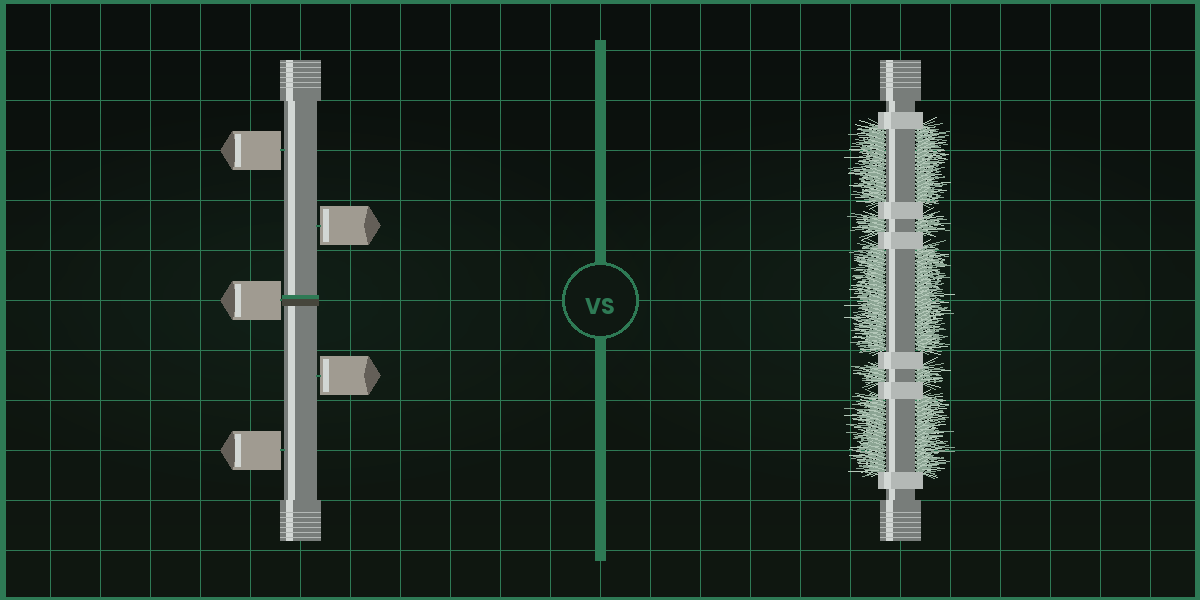
In this guide: What casing scrapers and casing brushes do, the key mechanical differences between them, when to use each, when to run both, and...